
Minors on Campus Program
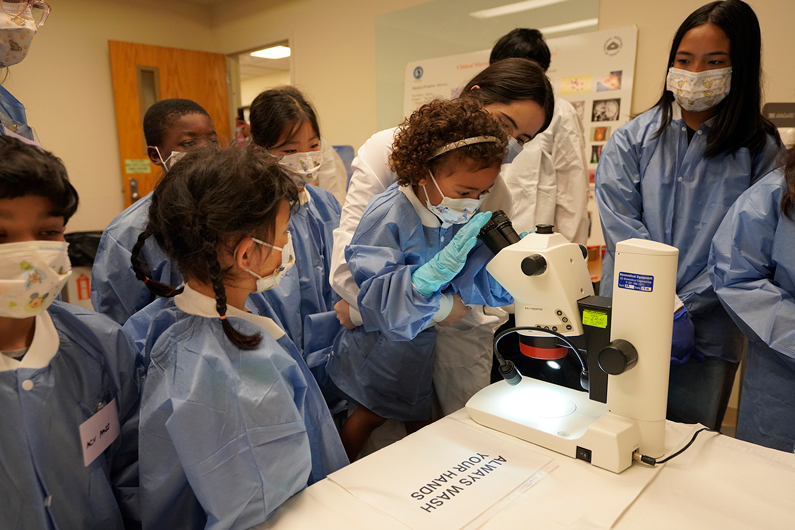
UNT Health provides opportunities for young inquisitive minds through programs aimed to educate and promote interest in higher education. The programs introduce children and youth to emerging technology tools as well as teaching them transferable skills that will help them pursue careers in the medical sciences.
We also provide education and guidance on sexual abuse and child molestation training as prescribed by the Texas Department of State Health Services (“TDSHS”) this training includes reporting suspected abuse, prohibition of certain kinds of physical and verbal interactions and one-on-one contact with minors.
For further information regarding minors on campus, please contact Dennys Arrieta.
The Process to Bring Minors to Campus
The Minors on Campus Policy 2.110 and processes help to ensure a positive environment that promotes health, wellness, safety, and security for children and teens.
To comply with all federal and state laws and regulations, the Office to Institutional Integrity and Awareness oversees the Minors on Campus process and participation requirements for all faculty, staff and students. This includes event and program registration, minimum staff ratios and parental consent and criminal background screenings.
The following information outlines the action items that must be accomplished at each stage of the process.
Action Items
- Chair/VP approval obtained for onsite, virtual, or hybrid activity.
- Supervision model and staffing plan defined early.
- Restricted areas and safety considerations identified.
Resources
Action Items:
- MOC Registration Form submitted with roster and schedule.
- Modality, ratios, emergency plan, and structure included.
- OIII review and readiness confirmation completed.
Resources:
Action Items
- Protecting Minors Training completed by all personnel.
- Background checks completed and verified (4 weeks).
- All adults fully compliant prior to participation.
Resources:
Action Items
- Parent/guardian consent forms collected.
- Emergency contacts + communication preferences documented.
- Media/photo expectations shared if applicable.
Resources
Action Items
- Minimum 2 cleared adults present at all times for every 1–10 minors.
- No unsupervised 1:1 interactions at any time.
- Incidents documented and reported to OIIA immediately.
Resources
Download PDF of Guidelines Checklist
Required Forms to Complete:
Understanding Program Requirement
Background checks and Child Abuse training are crucial for ensuring a safe environment for minors and providing peace of mind for their parents. These measures are not intended to create barriers; rather, they serve as a reassurance to everyone involved that UNT Health cares.
Background Checks
To uphold UNT Health’s Integrity Framework and ensure that minors are supported by qualified, ethical, and responsible adults, all program faculty, staff, students, and volunteers must complete a criminal background check. This process reinforces our commitment to accountability, safety, and transparency, fostering a secure and trustworthy environment for all Minors on Campus programs.
A background check is required when:
- A program or activity involves close interaction with minors (e.g., skills lab)
- Other program-specific factors necessitate a background check.
For verification on whether a background check is required, please contact the Office of Institutional Integrity and Awareness at compliance@unthealth.edu or call 817-735-0272.
Reporting Child Abuse
UNT Health is committed to protecting children and other vulnerable populations by fulfilling the institution’s obligation to report abuse and neglect as required by Texas Law. All faculty, staff, students and volunteers who have cause to believe that a child’s physical or mental health or welfare has been adversely affected by abuse and/or neglect by any person shall make an immediate report to the appropriate agencies.
Regardless of the laws specifying mandatory reporters and the scope of their duties, it is our policy (2.104 Reporting Abuse or Neglect) that you, as an employee, student or volunteer of our institution, report any incident of child abuse that you observe, learn of or suspect.
Required Training
All faculty, staff, students, and volunteers are required to take sexual abuse and child molestation training and examination as prescribed by the Texas Department of State Health Services (“TDSHS”). Please click on the link below to complete the required training.
The Office of Institutional Integrity and Awareness is required to submit to the Texas Department of State Health Services (“TDSHS”), within 5 days of the start of the program, verification that each individual who is involved in the program has successfully completed training on a form prescribed by TDSHS.
Where to Report Abuse
- Any local or state law enforcement agency, including the UNT Health Police Department
- The Department of Family and Protective Services (“DFPS”) or the agency designated by a court as responsible for the protection of children
- The state agency that operates licenses, certifies or registers a facility if the abuse or neglect is believed to have occurred in a state operated, licensed, certified of registered facility
- The Texas Youth Commission if the report is based on information provided by a child while under the supervision of the commission concerning the child’s alleged abuse of another child.
- The Texas Abuse Hotline at 1-800-252-5400 or online at https://www.txabusehotline.org/Login/Default.aspx
Keeping Everyone Safe
The safety of everyone participating in the program or activity is important. To reduce the risk of potential issues, please refer to the following guidelines when hosting a Minors on Campus Program.
- One-on-one interactions between program adults and minors should be limited (i.e., at least two adults should be present at all times with minors). No adult should ever be alone with a minor in an isolated place. In situations that require personal conferences, the meeting is to be conducted in view of other program adults.
- No minor should ever sit on the laps of program adults.
- No frontal hugs. An adult from time to time may feel a minor needs a hug for support or comfort. The adult must use a shoulder to shoulder hug.
- Contact between program adults and minors are restricted to organization-sanctioned activities and times. Program adults should not contact minors outside of program activities or program specific needs.
- Rough housing or hazing is prohibited. No program adult or minor is to participate in any kind of hazing or initiation activity. Program adults will not wrestle, tickle, or in any way engage a minor in an activity where the adult’s hands might come in contact with the breasts or genital area of the minor.
- Wear appropriate attire. Adults will be dressed modestly at all times. Clothes such as swimsuits, shorts, and tops are not to be revealing or in any way draw attention to the breasts, buttocks, or genital area. Equally important, program adults should monitor the clothing worn by minors. Clothing should follow the same guidelines above and should be appropriate for the weather and program activities.
- Provide orientation of UNT Health Policies and procedures to Minors: For example, if Minors or Individuals will be in a laboratory, they will be oriented to safety or other site-specific policies or procedures.
- Control access to minors: Limit contact between minors and individuals not associated with the program. Monitor the comings and goings of all minors and adults who enter and leave the facility. Be particularly alert to opportunities that are presented when activities occur in public spaces.
- Conduct activities in spaces that are open and visible to multiple people. Ensure there are clear sight lines throughout activity spaces. Secure areas not used for program purposes (e.g., closets, storerooms) to prevent minors from being isolated.
* NOTE – UNT Health prohibits any overnight programs or activities for minors unless approved by the President