
UNT Health Fort Worth aligns with new Texas law to expand nutrition education
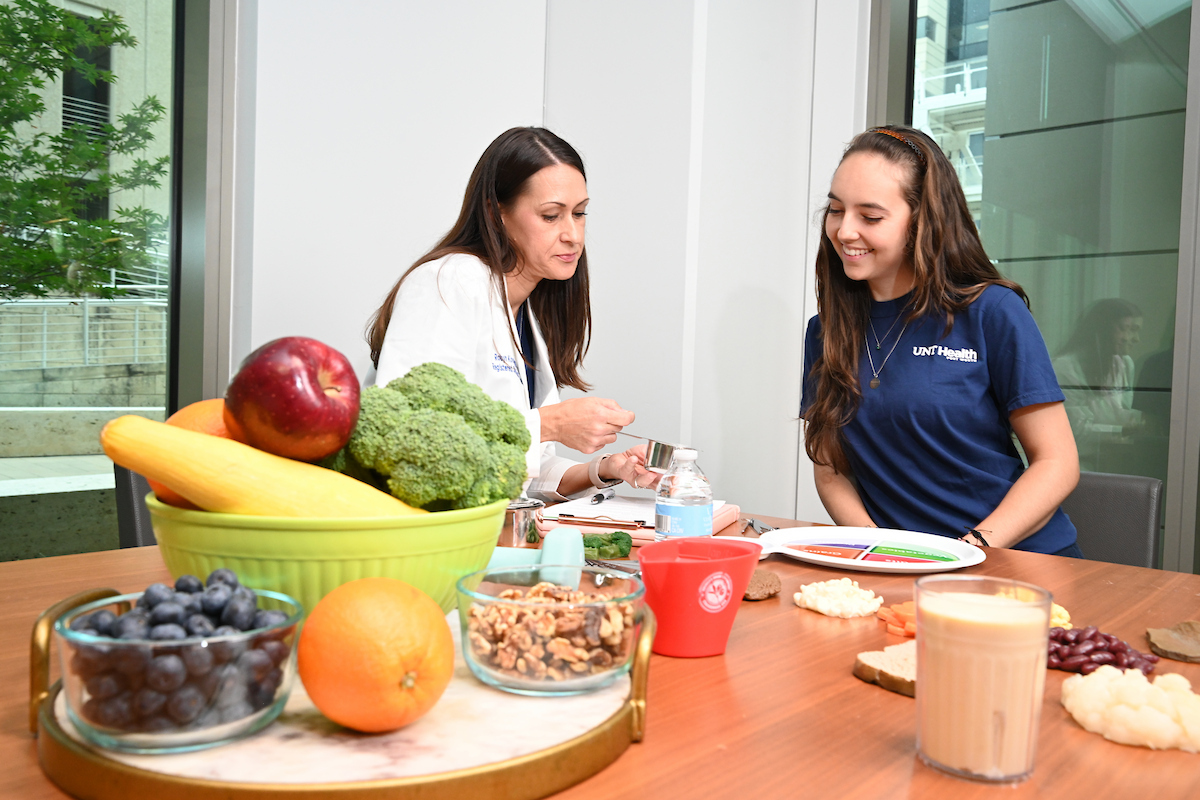 In a North Texas classroom, a lesson on food no longer ends with the food pyramid.
Students are learning how daily lifestyle and nutrition choices shape their long-term
health.
In a North Texas classroom, a lesson on food no longer ends with the food pyramid.
Students are learning how daily lifestyle and nutrition choices shape their long-term
health.
Across the state, that shift is gaining momentum.
At UNT Health Fort Worth, the concept of nutrition as medicine has been embedded in classrooms and clinics for years. Now, with the passage of Senate Bill 25 in September 2025 — which expands nutrition education for both health professionals and public school students — the university’s approach is aligning with a broader statewide effort to address chronic disease at its source.
“The Texas Legislature has recognized the importance of nutrition at all levels of health professions education with the passage of SB 25,” said John McKenzie, executive director of UNT Health’s Division of Academic Innovation. “Specialized training in nutrition and lifestyle medicine is something UNT Health has promoted and built for years, and it’s encouraging to see our state moving in the same direction.”
The law reflects a growing recognition that diet and lifestyle drive many of the nation’s most persistent health challenges. More than 80% of health care spending in the United States is tied to preventable, lifestyle-related conditions, according to public health estimates, and those conditions are appearing earlier in life.
At UNT Health, two initiatives — one aimed at future clinicians and another at teenagers — illustrate how institutions are working to close that gap.
The university’s College of Health Professions is preparing to launch a Master of Science in Clinical Nutrition, designed to train registered dietitian nutritionists to meet rising demand. The program emphasizes flexible, science-based instruction and aims to prepare graduates to translate research into practical care.
“We are starting a clinical nutrition program to train the next generation of registered dietitian nutritionists who will make a great impact in the community,” said Christina Liew-Newville, Ed.D., the program’s director.
The emphasis, she said, is on prevention as much as treatment. “Nutrition is the foundation of health,” she said, adding that equipping clinicians with even a baseline understanding can help them address patient needs earlier and more effectively.
Under SB 25, health professional programs across Texas must incorporate nutrition training into their curricula, whether through new coursework or expanded content in existing classes. The law also introduces continuing education expectations for licensed providers.
Beyond universities, the legislation requires public high schools to offer a half-credit course in nutrition, opening the door for new partnerships between higher education and K-12 systems.
At UNT Health, one such effort was already underway.
The Lifestyle Medicine for Teens microcredential, a free, online, self-paced course, introduces adolescents to the fundamentals of health, including nutrition, physical activity, sleep and stress management.
“This really started with a high school student who saw a gap and wanted to help other teens learn how to live healthier lives,” said Teresa Wagner, DrPH, a registered dietitian and faculty member who helped bring the program to life.
The idea originated during the pandemic, when Aravind Venkatachalam, then a North Texas high school student, began searching for ways to make health education more engaging and accessible.
“There wasn’t anything available that was truly built for students,” Venkatachalam said. “A lot of health classes felt like something you just had to get through.”
Working with faculty mentors, including Wagner, he helped shape a curriculum designed to feel relevant and practical, not abstract or academic.
“What makes this different is that it was designed for youth, by youth, so it actually speaks to them in a way traditional health education often doesn’t,” Wagner said.
The curriculum is built around key pillars of lifestyle medicine — nutrition, movement, sleep, stress management, avoidance of risky substances and social connection — offering students a broader understanding of how habits influence long-term health.
“Lifestyle medicine isn’t just about one thing — it’s how nutrition, movement, sleep, stress, substance avoidance and social connection all work together,” Wagner said.
For Venkatachalam, success is not measured solely in course completions but in whether students leave with new awareness.
“Even just knowing something they didn’t know before, that’s success,” he said.
That goal reflects a broader emphasis on early intervention.
“If we want to change the trajectory of chronic disease, we have to reach people earlier, when habits are still forming,” Wagner said.
The program has already begun to attract attention beyond Texas. More than 50 students at Boston University and several at Harvard Medical School are expected to use the microcredential as part of their training, with some going on to work with high school students this summer.
McKenzie said the scalability of the course makes the program well suited to meet the requirements of SB 25.
“What the state is asking for is exactly the kind of entry point this provides,” he said. “It’s accessible, evidence-based and can be deployed quickly.”
Discussions are underway with school districts and partner institutions across Texas, with the long-term goal of offering the program as a ready-made solution for high schools seeking to meet the new mandate.
For Wagner, the effort represents both a prevention strategy and a long-term investment in the future of health care.
“It’s not just about learning information,” she said. “It’s about making it practical and relevant so teens can actually use it in their daily lives.”
At UNT Health, an ecosystem spanning degree programs, microcredentials and community partnerships continues to take shape, reflecting a growing consensus that the nation’s health challenges may be addressed as much outside the clinic as within it.
And increasingly, that work is beginning earlier than ever.